


Credit card debt spirals quickly in Memphis. High balances, mounting interest, and missed payments damage your credit score and drain your bank account month after month.
We at Hurst Law Firm, P.A. help Memphis residents tackle credit card issues head-on. This guide walks you through practical debt management strategies and explains when bankruptcy becomes your strongest option.
What Credit Card Debt Does to Your Finances
Your Credit Score Takes a Beating
Credit card debt destroys your credit score faster than almost any other financial mistake. Each missed payment tanks your score by 100 to 150 points, according to data from the Fair Isaac Corporation. High balances above 30 percent of your credit limit compound the damage monthly. Your score drops not just from missed payments but from high utilization ratios alone-even if you pay on time, maxing out cards wounds your creditworthiness.
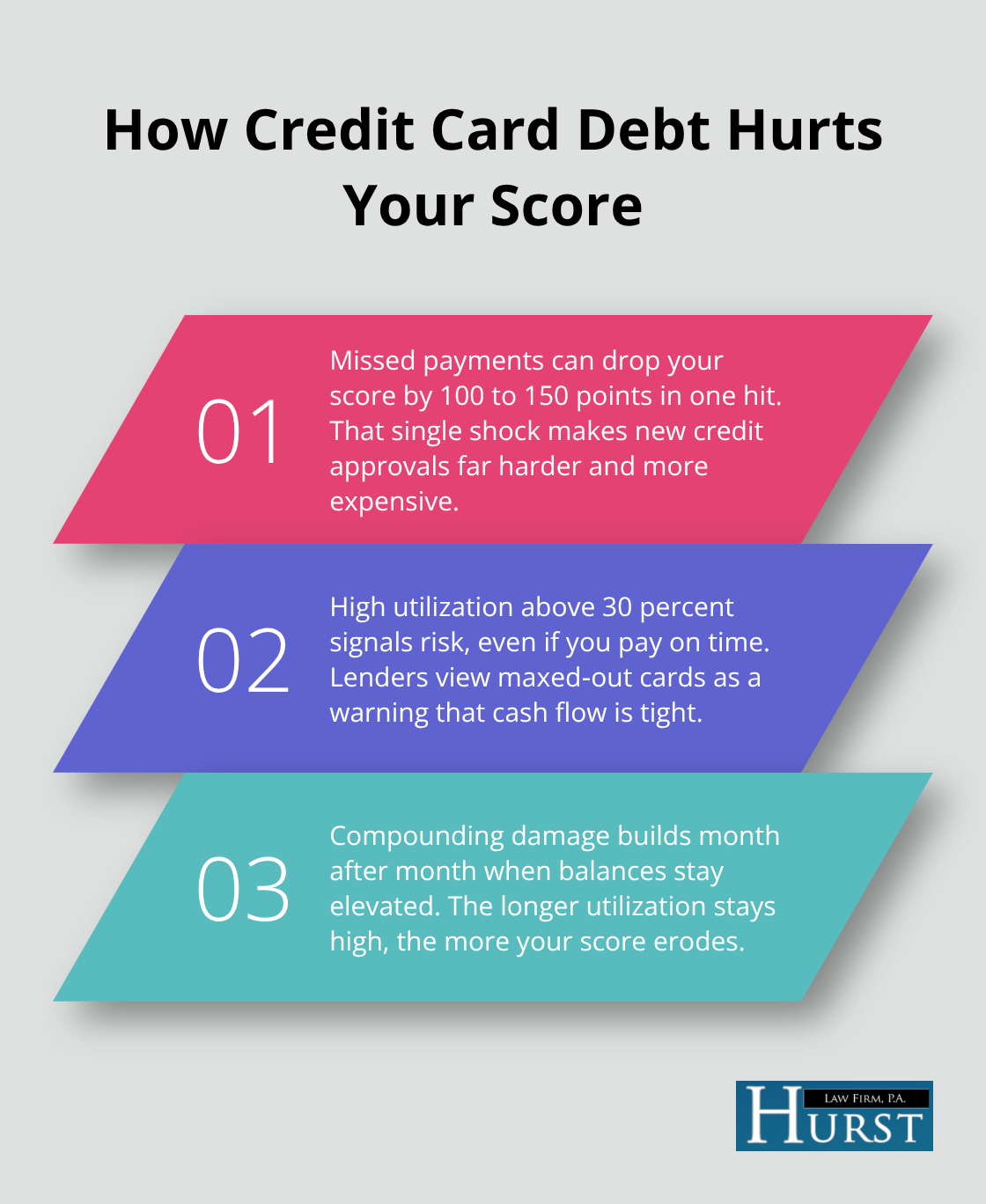
Lenders see high utilization as a red flag that you’re financially stretched thin.
Getting approved for a mortgage, car loan, or even renting an apartment becomes nearly impossible when your credit score falls below 620. The interest rate penalties are brutal too. The average credit card APR in 2024 sits at 21.5 percent according to the Federal Reserve, and rates for customers with poor credit exceed 25 percent. On a 10,000 dollar balance, that’s 2,150 dollars in annual interest charges alone, meaning your debt grows even when you make payments.
The Psychological Toll Runs Deep
The stress of credit card debt matches the financial damage. Studies from the American Psychological Association show that financial stress is the leading cause of anxiety and depression among adults. Credit card debt keeps you trapped in a cycle where minimum payments barely cover interest, leaving the principal untouched for years. Many Memphis residents report losing sleep, experiencing relationship strain, and struggling to focus at work because of mounting debt.
The stress doesn’t just feel bad-it affects your health. People under severe financial stress have higher blood pressure, weakened immune systems, and increased risk of heart disease (according to research from the American Heart Association). You’re not just losing money; you’re losing peace of mind. The longer you wait to address credit card debt, the worse both the financial and emotional consequences become.
Why Action Matters Now
Taking action now matters far more than hoping the problem resolves itself. The debt won’t shrink on its own, and the damage to your credit and mental health accelerates with each passing month. Understanding how credit card debt harms you is the first step toward recovery. The next step involves learning practical strategies to regain control-and knowing when those strategies aren’t enough.
How to Take Back Control Before Bankruptcy
Track Your Spending with Precision
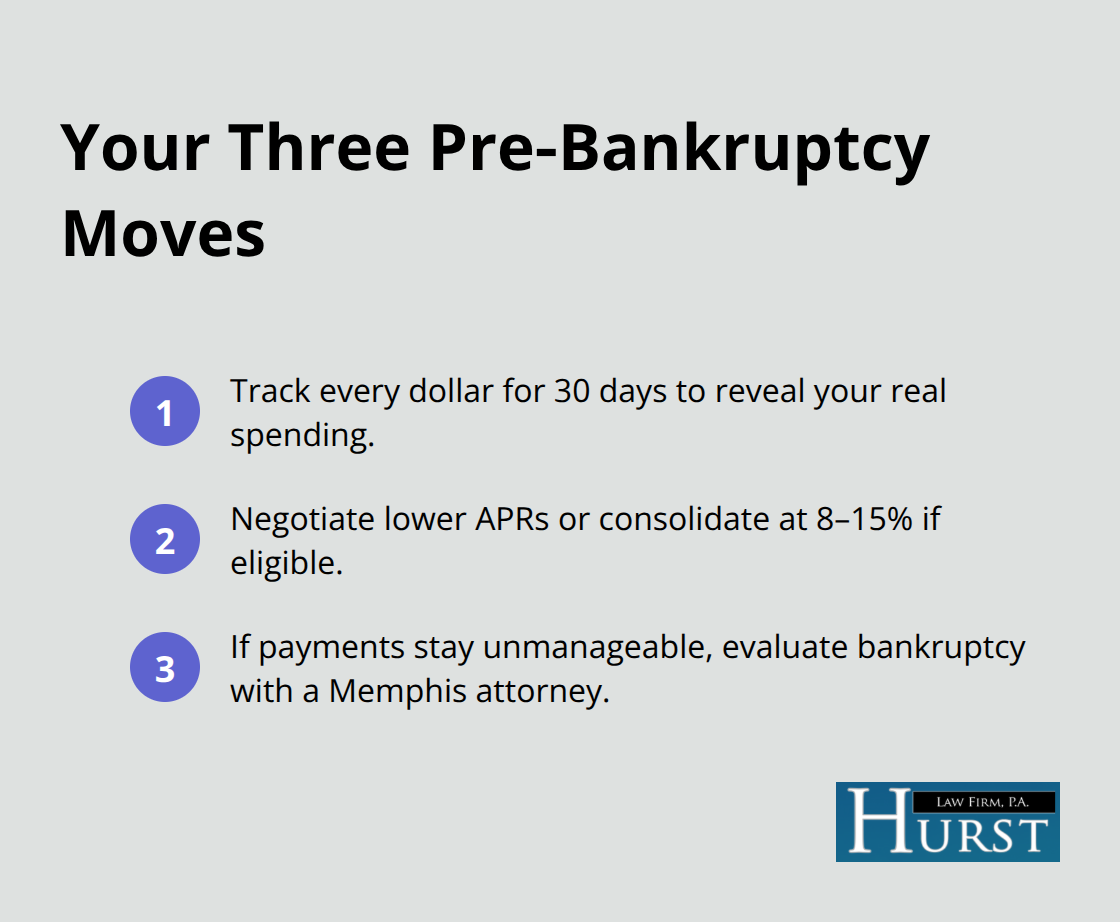
The gap between drowning in credit card debt and filing for bankruptcy is wider than most Memphis residents realize. Start with a realistic budget that tracks every dollar you spend for 30 days straight. Most people vastly underestimate their spending until they see actual numbers. Use free tools like Mint or YNAB to categorize expenses, identify waste, and find money you didn’t know existed. The Federal Reserve reports that households carrying credit card debt average 6,948 dollars in balances, yet many never calculate exactly how much interest they pay monthly.
Once you know your true spending pattern, you can redirect even small amounts toward debt reduction. Paying 50 dollars extra monthly on a 10,000 dollar balance at 21.5 percent APR cuts your payoff time from nearly 7 years to under 5 years and saves thousands in interest charges. This single step transforms your financial trajectory without requiring drastic lifestyle changes.
Negotiate Lower Rates or Consolidate Your Debt
Creditor negotiation works when you approach it strategically rather than emotionally. Call your card issuer and ask for a lower interest rate, citing your payment history and other accounts you manage responsibly. Credit card companies would rather negotiate than lose you to bankruptcy, where they recover nothing. If your credit score has dropped significantly, you hold a stronger negotiating position than you think because the company knows you’re at risk of default.
Debt consolidation through a personal loan at a lower rate combines multiple card balances into one payment, which simplifies your finances and reduces overall interest. Banks and credit unions offer consolidation loans at rates between 8 and 15 percent, depending on your credit score, compared to the 21.5 percent average card rate. However, consolidation only works if you stop accumulating new credit card debt immediately. Too many Memphis residents consolidate, then max out their cards again, doubling their total debt.
When Bankruptcy Becomes Your Realistic Path Forward
If negotiation and consolidation fail to reduce your monthly obligations to manageable levels, bankruptcy becomes the realistic option rather than the last resort. Three practical strategies exist before this point, and each one demands action rather than wishful thinking. Yet when these approaches don’t work, you need to understand what bankruptcy actually offers Memphis residents facing overwhelming credit card balances.
Bankruptcy Stops Credit Card Debt Cold
Chapter 7 Wipes Out Credit Card Balances
Chapter 7 bankruptcy eliminates credit card debt entirely for Memphis residents who qualify. The U.S. Courts reported that Chapter 7 filers discharged an average of 24,000 dollars in unsecured debt during 2023, with credit cards accounting for the majority of that total. When you file Chapter 7, a trustee liquidates non-exempt assets to pay creditors, but most Memphis residents keep their homes, cars, and personal belongings because Tennessee exemption laws protect primary residences and vehicles under certain value thresholds. The discharge takes four to six months, and once it’s complete, credit card companies cannot pursue collection actions, wage garnishment, or lawsuits. Your credit card balances simply vanish-this isn’t a payment plan or a negotiation, but a legal erasure of the debt.
The psychological relief alone justifies the filing for many people who’ve spent years under the weight of impossible balances. You stop receiving collection calls, cease worrying about lawsuits, and regain control of your paycheck. The fresh start that Chapter 7 provides extends far beyond the numbers on your credit report.
Chapter 13 Creates a Structured Repayment Path
Chapter 13 offers a different solution when you have a stable income but cannot eliminate debt entirely. Instead of wiping out balances, Chapter 13 consolidates your credit cards into a court-approved repayment plan lasting three to five years, according to the American Bankruptcy Institute. You make one monthly payment to a trustee, who distributes funds to creditors according to the court’s priority system. Chapter 13 stops interest accrual on unsecured debt immediately, meaning your payment goes directly toward principal rather than enriching credit card companies with predatory interest rates.
A Memphis resident with 35,000 dollars in credit card debt at 22 percent APR would pay roughly 600 dollars monthly under Chapter 13 for five years, totaling 36,000 dollars, compared to paying over 52,000 dollars through minimum payments alone. Chapter 13 also protects your home from foreclosure and your car from repossession if you’re behind on those payments, making it the stronger choice when you have assets worth protecting.
Choosing Between Chapter 7 and Chapter 13
Your income level and asset situation determine which bankruptcy chapter fits your circumstances. Chapter 7 requires you to pass the means test, which compares your income against the Tennessee median (currently around 65,000 dollars for a family of four). If your income falls below this threshold, you qualify for Chapter 7 and can eliminate debt without a repayment plan. If your income exceeds the median, Chapter 13 becomes your path forward because you have the ability to repay at least some portion of your debt.
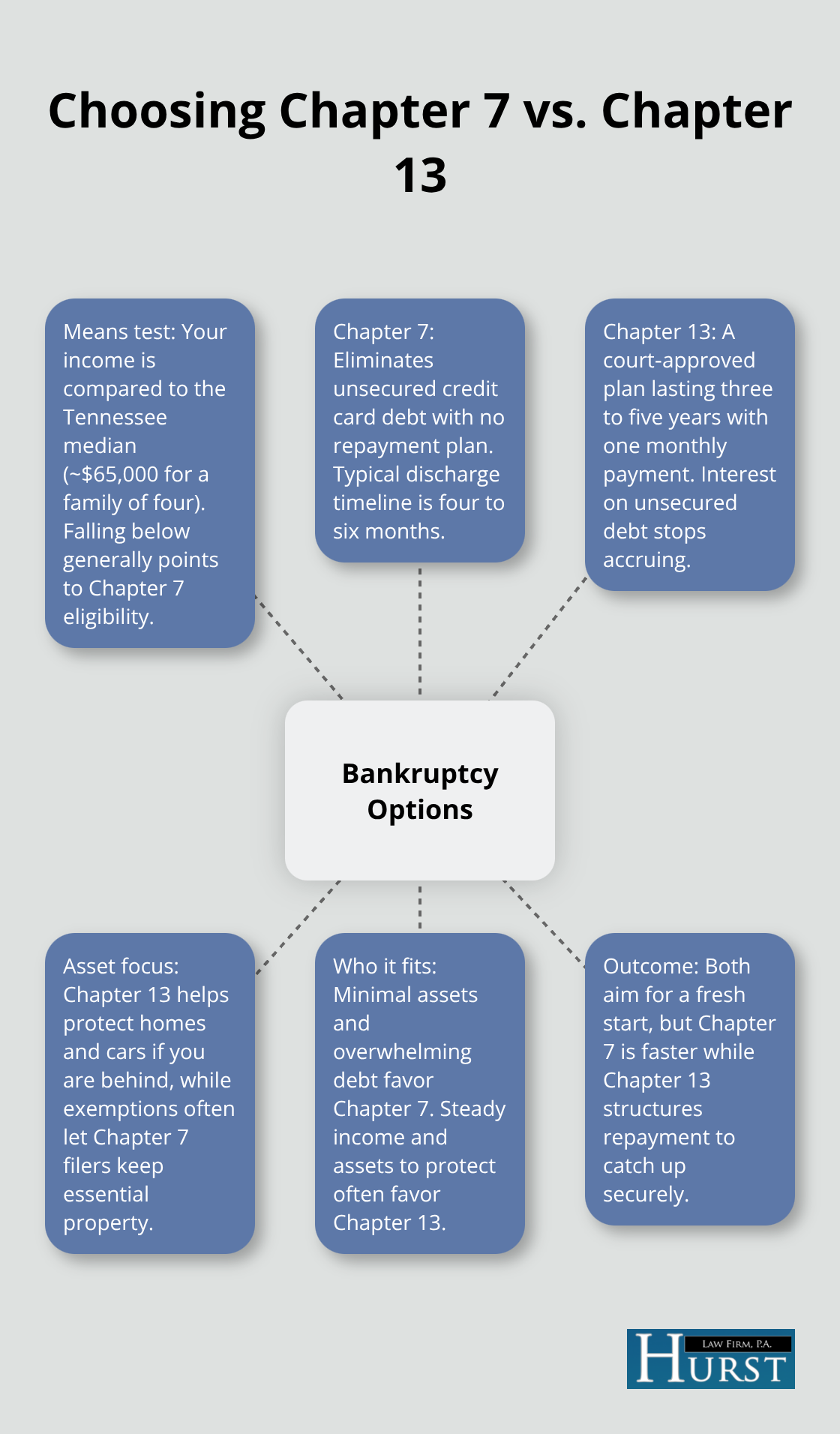
The choice also depends on what you’re trying to protect. If you own a home with significant equity or a vehicle you cannot afford to lose, Chapter 13 shields these assets while you repay creditors over time. If you have minimal assets and overwhelming debt, Chapter 7 offers the quickest path to a fresh start. Hurst Law Firm, P.A., a bankruptcy law firm in Memphis led by attorney Herbert Hurst, has assisted the Memphis community since 1997 in evaluating these options and determining which chapter matches your specific financial circumstances and recovery goals.
Final Thoughts
Credit card debt doesn’t have to control your life forever. You’ve learned three practical pathways forward: tracking spending to find hidden money, negotiating with creditors or consolidating balances, and understanding how bankruptcy provides a legal reset when other strategies fall short. Memphis credit card issues affect thousands of residents, yet most never realize they have options beyond minimum payments and mounting stress.
Chapter 7 bankruptcy eliminates unsecured debt entirely for those who qualify, while Chapter 13 creates a manageable repayment structure that stops interest from compounding. Both chapters offer Memphis residents a genuine fresh start rather than years of financial struggle. The choice between them depends on your income level, assets, and what you’re trying to protect, but either path beats the slow bleed of credit card interest rates that average 21.5 percent annually.
Contact Hurst Law Firm, P.A. for a consultation to evaluate your situation. We’ll review your income, debts, and assets to determine whether Chapter 7, Chapter 13, or another debt management strategy makes sense for your recovery. Financial recovery starts with one decision to stop accepting debt as permanent.