

Facing mounting debt forces many people to choose between two paths: debt consolidation or bankruptcy. Each option carries different consequences for your finances and credit history.
At Hurst Law Firm, P.A., we help clients understand which route makes sense for their situation. This guide breaks down the real differences so you can make an informed decision.
How Debt Consolidation Works
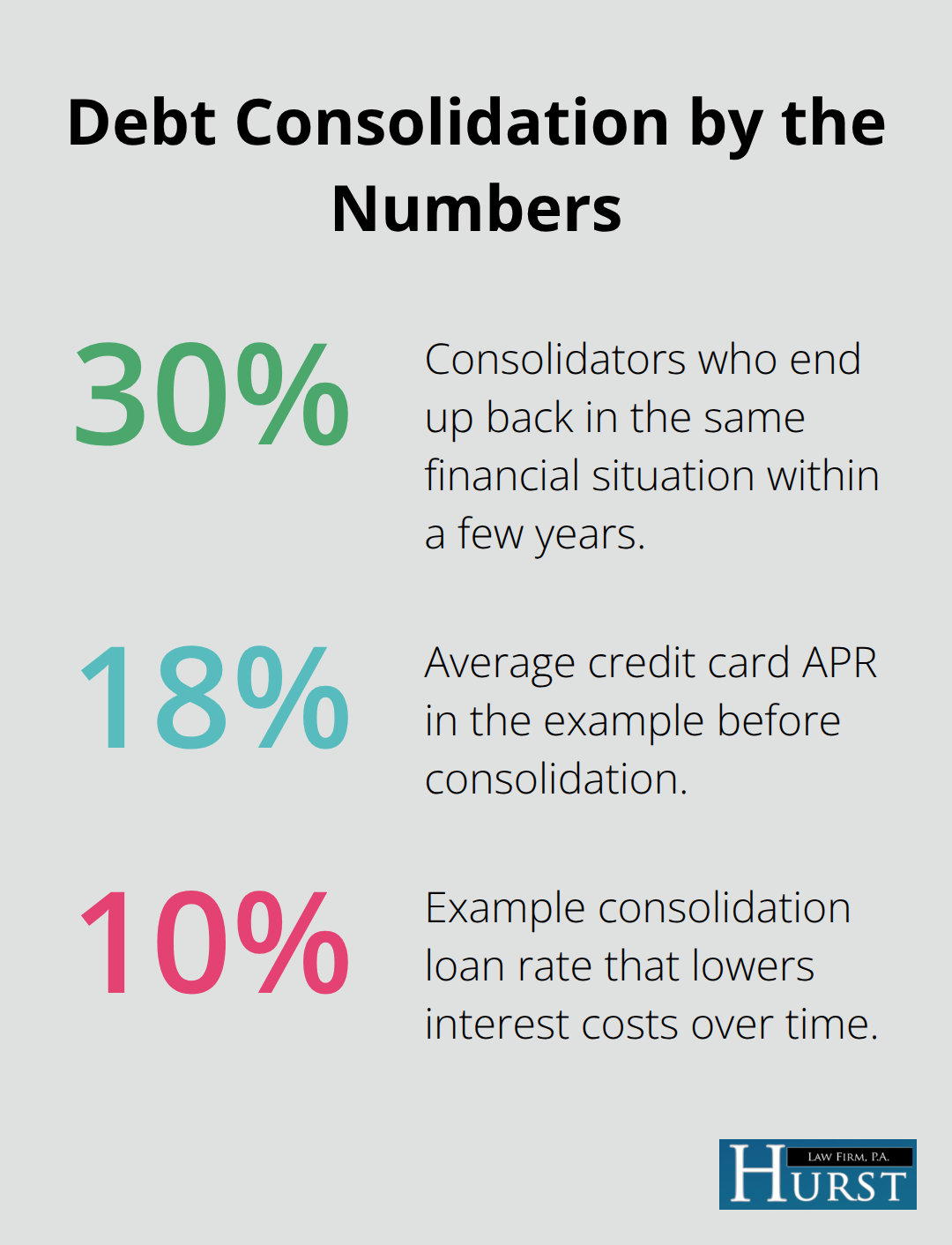
Debt consolidation combines multiple debts into a single loan with one monthly payment. The most common approach involves taking out a personal loan to pay off credit cards, medical bills, or other unsecured debts. A secured consolidation loan uses your home or vehicle as collateral, which typically lowers your interest rate but puts your assets at risk. Unsecured consolidation loans don’t require collateral but carry higher interest rates, usually between 6% and 36% depending on your credit score and the lender.
The Real Math Behind Consolidation
The goal is straightforward: reduce your interest rate and simplify payments. If you carry $25,000 across five credit cards at an average 18% interest rate, you pay roughly $375 monthly in interest alone. A consolidation loan at 10% could cut that interest cost significantly over time. However, consolidation only works if you stop accumulating new debt. Studies from the Federal Reserve show that roughly 30% of people who consolidate their debts end up in the same financial situation within a few years because they continue using credit cards. The math fails when you treat consolidation as a fresh start rather than a behavior change.
When Consolidation Makes Sense
Consolidation works best when your debt-to-income ratio is manageable and your credit score is decent enough to qualify for a lower interest rate. Most lenders require a credit score above 600, though better rates kick in around 670 or higher. If you earn $4,000 monthly and owe $15,000 total, consolidation can reduce your monthly obligation from $400 across multiple payments to $300 on a single loan. The timeline matters too-consolidation typically takes three to seven years, while bankruptcy can provide relief in months. You need stable income and the ability to commit to consistent payments without accumulating new balances.
Moving Forward With Your Decision
Consolidation addresses the symptom of debt but not always the underlying problem. If your income has dropped, your expenses exceed what you earn, or you face medical debt that continues to grow, consolidation may only delay the inevitable. Bankruptcy, on the other hand, addresses the root issue by eliminating or restructuring debts you cannot repay. Understanding which path fits your situation requires looking at your total financial picture-not just your monthly payment amount.
When Bankruptcy Actually Makes Sense
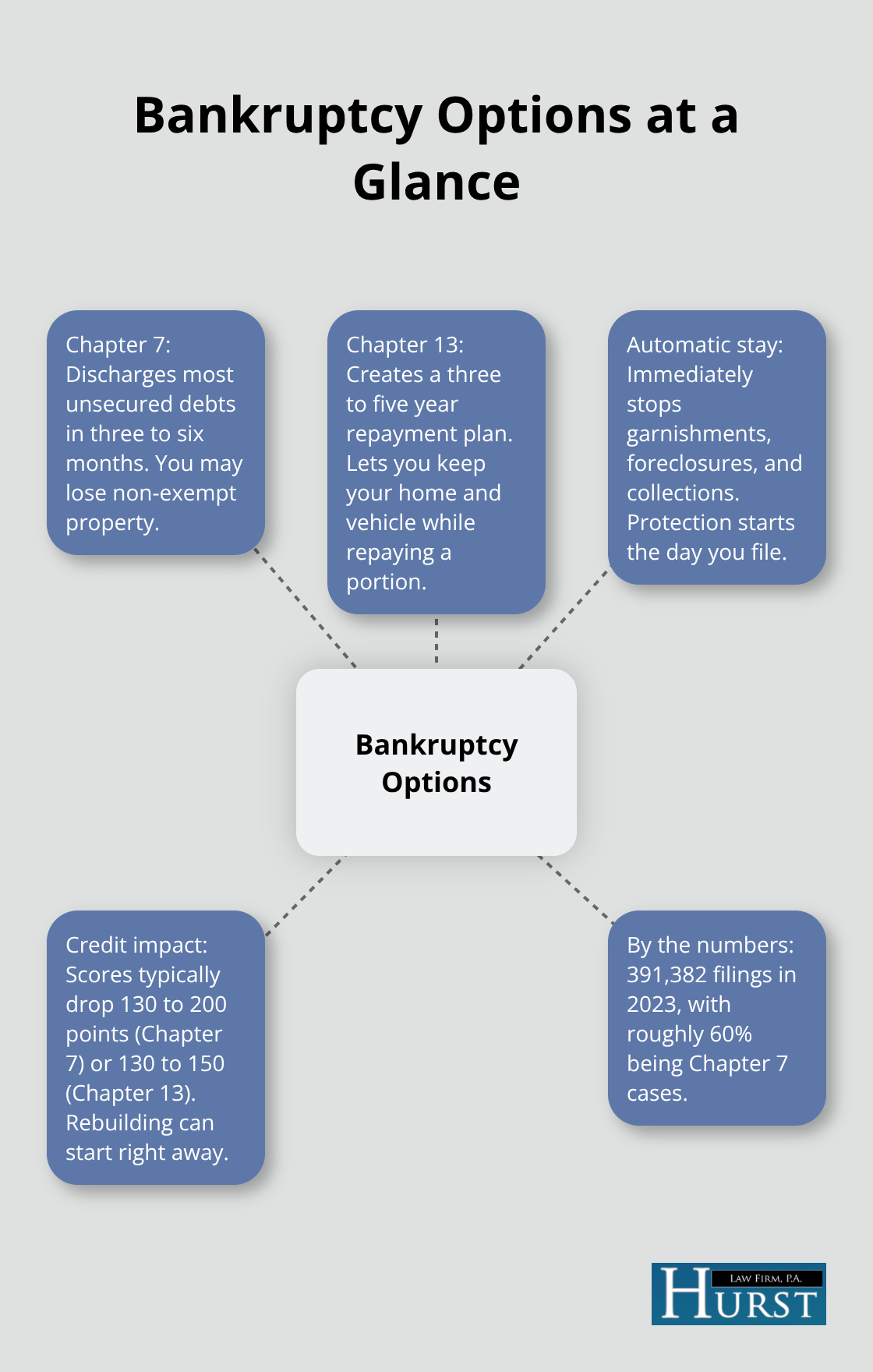
Bankruptcy exists for one reason: when your debts exceed your ability to repay them, period. Unlike consolidation, which assumes you can eventually pay what you owe, bankruptcy acknowledges that some financial situations are unsalvageable through payment plans alone. Chapter 7 bankruptcy liquidates your assets to eliminate most unsecured debts within three to six months. You lose non-exempt property, but walk away from credit cards, medical bills, and personal loans. Chapter 13 bankruptcy restructures your debts into a repayment plan lasting three to five years, allowing you to keep your home and vehicle while paying back a portion of what you owe. The U.S. Courts reported 391,382 bankruptcy filings in 2023, with roughly 60% being Chapter 7 cases.
This matters because bankruptcy isn’t rare or shameful-it’s a legal tool designed for situations where consolidation fails.
Who Should File Chapter 7
Chapter 7 works when your income falls below your state’s median and you have minimal assets to protect. The means test, an official calculation used by bankruptcy courts, determines eligibility. If you earn $45,000 annually and owe $80,000 in unsecured debt with no significant equity in property, Chapter 7 eliminates most obligations without requiring payments. The filing fee runs roughly $335 plus attorney costs. Chapter 7 damages your credit score by 130 to 200 points initially, but the filing drops off your credit report after ten years. You can rebuild immediately through secured credit cards and authorized user accounts, with many filers reaching 650-plus scores within two years.
Who Needs Chapter 13
Chapter 13 applies when you earn above your state’s median income or want to keep assets like your home. You propose a repayment plan that pays creditors a percentage of your debt over time, typically 0% to 100% depending on your disposable income. The trustee overseeing your case receives monthly payments and distributes them to creditors. If you earn $6,000 monthly with a $2,000 mortgage and $1,500 in other expenses, your disposable income is roughly $2,500-which determines how much you repay. Chapter 13 stops foreclosure immediately, giving homeowners breathing room to catch up on missed payments within the plan. Your credit takes a hit similar to Chapter 7, but the filing shows active debt repayment, which appeals to future lenders.
The Real Triggers for Filing
Bankruptcy makes sense when you face wage garnishment, foreclosure, or medical debt spiraling beyond control. If your employer garnishes 25% of your paycheck for a judgment, bankruptcy stops that immediately through the automatic stay. Medical debt accounts for roughly 66% of bankruptcies according to the American Journal of Public Health, often triggered by job loss or inadequate insurance. Foreclosure timelines vary by state but move fast-typically 120 days from first notice to auction. Filing bankruptcy halts the sale, giving you months to decide whether to catch up payments, surrender the property, or modify the loan. Consolidation cannot stop these actions; only bankruptcy’s automatic stay provides that protection.
Understanding which bankruptcy chapter fits your situation requires examining your income, assets, and the specific debts threatening your financial stability. The next section compares how these two paths-consolidation and bankruptcy-affect your credit score and timeline for recovery.
How Consolidation and Bankruptcy Affect Your Financial Recovery
Credit Score Impact: The Numbers Matter
Consolidation and bankruptcy create vastly different credit impacts, and the numbers tell a clear story about which path recovers faster. Consolidation takes an immediate hit of 50 to 100 points when you apply for a consolidation loan, but recovery starts within months if you make on-time payments. After one year of perfect payment history, most borrowers see scores climb 80 to 120 points. After three years, scores often reach 680 to 720 if no new delinquencies occur. Bankruptcy delivers a harder initial blow-Chapter 7 drops your score 130 to 200 points, while Chapter 13 causes a 130 to 150 point decline.
However, bankruptcy recovery actually accelerates faster than consolidation in practical terms. The U.S. Courts data shows that bankruptcy filers can rebuild to 650-plus scores within two years through secured credit cards and becoming authorized users on established accounts. Consolidation requires you to maintain the same single loan payment without any slip-ups for three years just to reach comparable scores. This matters because bankruptcy stops the bleeding immediately, whereas consolidation assumes you’ll maintain discipline for years while your score slowly recovers.
Timeline to Financial Recovery
Consolidation typically requires three to seven years of consistent payments, during which your credit score gradually improves as you demonstrate reliability. You must avoid any missed payments or new delinquencies during this entire period to reach solid credit standing. One missed payment can reset your progress and extend your recovery timeline by months.
Bankruptcy provides faster practical recovery despite the initial score damage. Chapter 7 eliminates most unsecured debts within three to six months, allowing you to start rebuilding immediately. Chapter 13 restructures your debts over three to five years, but you begin rebuilding your credit from month one since the plan shows active debt repayment. Lenders view Chapter 13 filers more favorably than those stuck in multi-year consolidation plans because the bankruptcy shows you took decisive action rather than attempting to stretch payments indefinitely.
Cost Comparison: What You Actually Pay
Consolidation fees range from 0% to 8% of your loan amount, meaning a $25,000 consolidation loan costs $0 to $2,000 upfront, plus interest rates between 6% and 36% over the repayment period. That $25,000 consolidation loan at 10% over six years costs roughly $8,300 in interest alone. You repay the full amount plus all accumulated interest.
Chapter 7 bankruptcy costs approximately $335 in filing fees plus attorney fees ranging from $1,500 to $3,500 depending on complexity, totaling roughly $2,000 to $4,000 with legal representation. Chapter 13 costs the same filing fee but attorney fees typically run $2,500 to $4,000 since the trustee collects payments from your disposable income over three to five years.
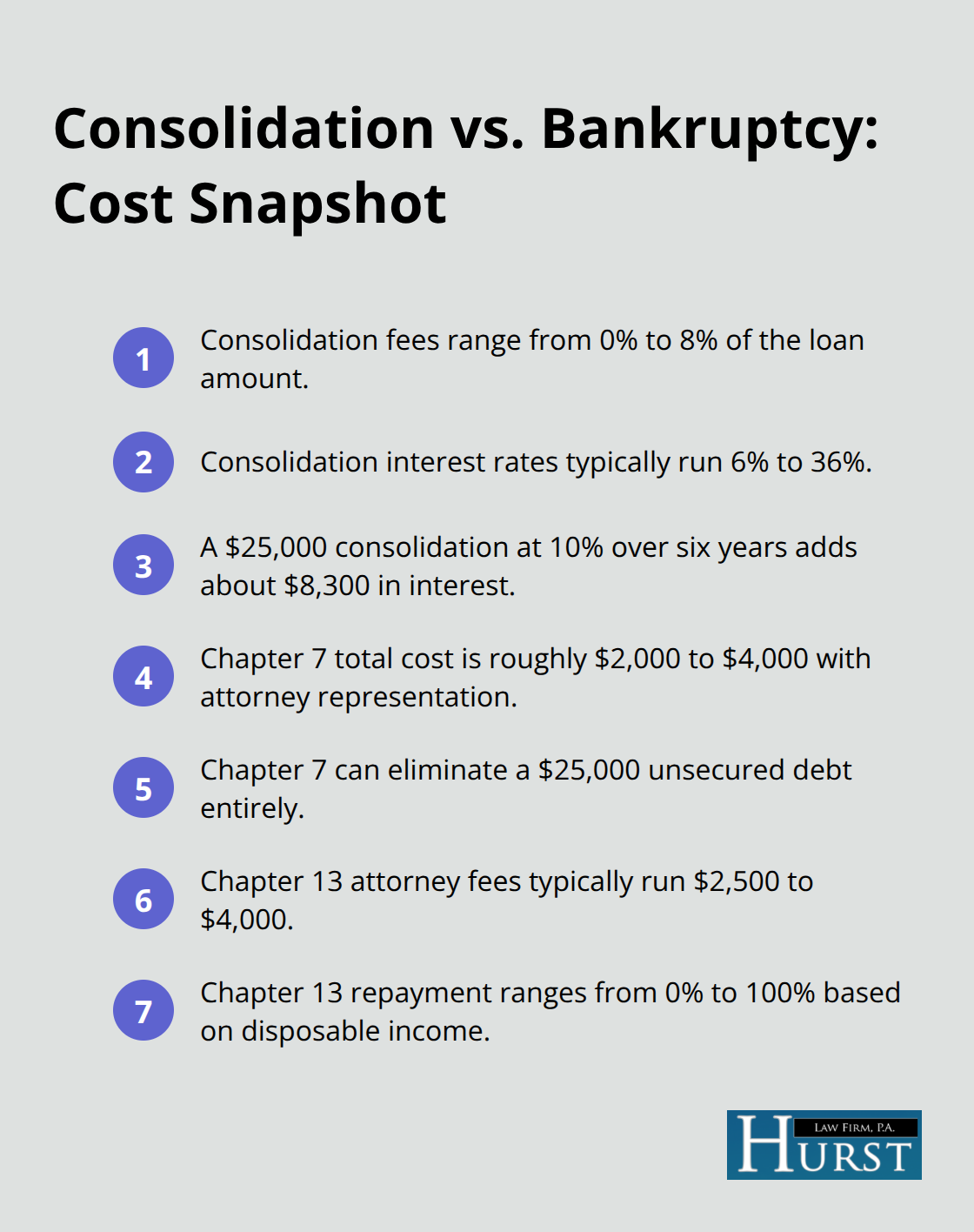
The critical difference is outcome: that $25,000 consolidation loan requires you to repay the full amount plus $8,300 in interest. Chapter 7 bankruptcy eliminates the same $25,000 debt entirely for a one-time cost under $4,000. Chapter 13 lets you repay 0% to 100% of debts depending on your disposable income calculation, meaning you might pay back only $10,000 of that $25,000 while the remainder gets discharged.
Long-Term Financial Health: The Real Test
Long-term financial health depends on whether you can actually afford the monthly payment without accumulating new debt. Consolidation works only if your income genuinely covers your expenses plus the consolidated payment. If it doesn’t, bankruptcy provides the reset consolidation cannot deliver. The Federal Reserve found that roughly 30% of people who consolidate their debts end up in the same financial situation within a few years because they continue using credit cards after consolidation. Consolidation addresses the symptom of debt but not always the underlying problem. If your income has dropped, your expenses exceed what you earn, or you face medical debt that continues to grow, consolidation may only delay the inevitable. Bankruptcy acknowledges that some financial situations are unsalvageable through payment plans alone and provides a legal path forward.
Final Thoughts
Debt consolidation versus bankruptcy represents a fundamental choice about how you address financial distress. Consolidation assumes you can eventually repay what you owe through a single monthly payment, while bankruptcy acknowledges that some situations require eliminating or restructuring debts you cannot realistically repay. The numbers show consolidation works only when your income covers expenses plus the consolidated payment without accumulating new debt, yet Federal Reserve data reveals that 30% of consolidation attempts fail within a few years because people return to old spending habits.
Your decision hinges on three concrete factors. First, examine whether your income genuinely exceeds your monthly expenses and debt obligations-if it does, consolidation may work if you can secure a lower interest rate and commit to avoiding new debt. Second, assess what assets you need to protect, since Chapter 7 liquidates non-exempt property but eliminates most unsecured debts within months, while Chapter 13 lets you keep your home and vehicle while restructuring debts over three to five years. Third, consider your timeline for recovery, as bankruptcy filers reach 650-plus credit scores within two years, while consolidation requires three years of perfect payments just to reach comparable scores.
Medical debt, job loss, foreclosure threats, or wage garnishment typically signal that bankruptcy makes more sense than consolidation. We at Hurst Law Firm, P.A. help Memphis residents understand which path fits their situation, and we have guided individuals and families through Chapter 7 and Chapter 13 filings since 1997. Contact us to discuss your options with someone who understands your circumstances.