


A Chapter 13 repayment plan gives you a structured path to handle your debts while keeping your assets. Instead of liquidating everything, you reorganize what you owe and commit to a payment schedule over three to five years.
At Hurst Law Firm, P.A., we guide clients through every step of this process. This guide walks you through how these plans work, what the trustee does, and how to stay on track.
How Your Repayment Plan Gets Structured
A Chapter 13 repayment plan operates on a straightforward principle: you propose a payment schedule to the bankruptcy court, and if the court approves it, you make monthly payments to a trustee who distributes those funds to your creditors. The court requires your plan to demonstrate that you can afford the payments while covering your essential living expenses. This means the plan reflects your actual financial situation, not a theoretical one.
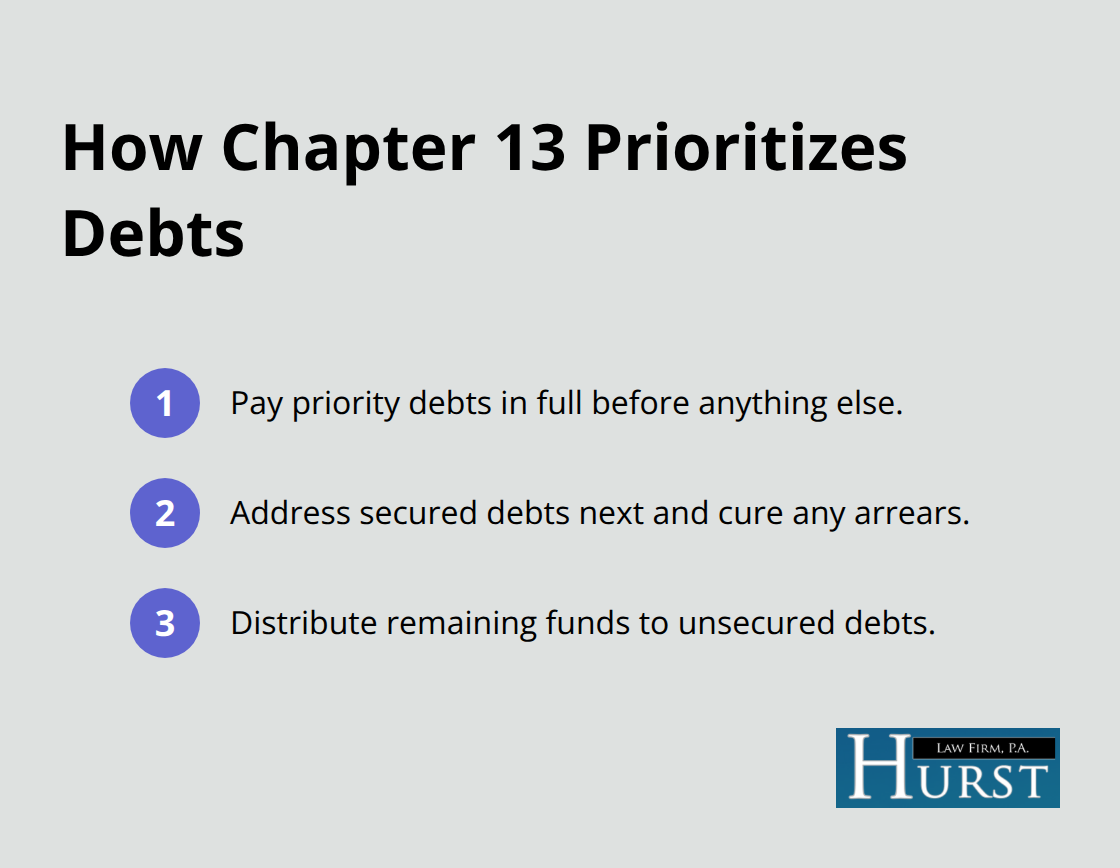
Your plan must account for priority debts first, such as recent tax obligations and child support, then secured debts like mortgages and car loans, and finally unsecured debts like credit cards and medical bills. The court will not confirm a plan that asks you to live below a reasonable standard or that ignores legitimate expenses.
According to data from the U.S. Courts, in 2024 approximately 194,055 Chapter 13 cases closed, with 97,063 resulting in discharge and successful completion. This relatively high success rate reflects that courts and trustees work to make plans realistic from the start.
Understanding Your Timeline and Payment Structure
Chapter 13 plans last either 36 or 60 months, meaning three or five years. Federal law does not allow plans to extend beyond five years, even if creditors request it. Most filers with below-median income qualify for a three-year plan if their disposable income after essential expenses can cover the required payments within that timeframe.
Above-median income filers typically receive a five-year plan to give more breathing room for higher debt loads or larger arrears amounts. Your monthly payment amount stays fixed unless your circumstances change materially (such as job loss or significant income increase). Payments typically begin within 30 days of filing, even before the court holds a confirmation hearing to formally approve your plan. This early start means you demonstrate commitment to the court and reduce the risk that creditors will object to your plan terms.
If your income drops during the plan, you can file a motion to modify the plan and reduce payments, though you must still dedicate all disposable income to the repayment effort.
The Trustee’s Role in Your Success
The bankruptcy trustee assigned to your case collects your monthly payments and distributes them according to your confirmed plan. This trustee also chairs your creditor meeting, reviews your financial documents, and enforces all plan requirements. The trustee’s role is neutral but active, meaning they protect creditors’ interests while also ensuring the plan remains feasible for you.
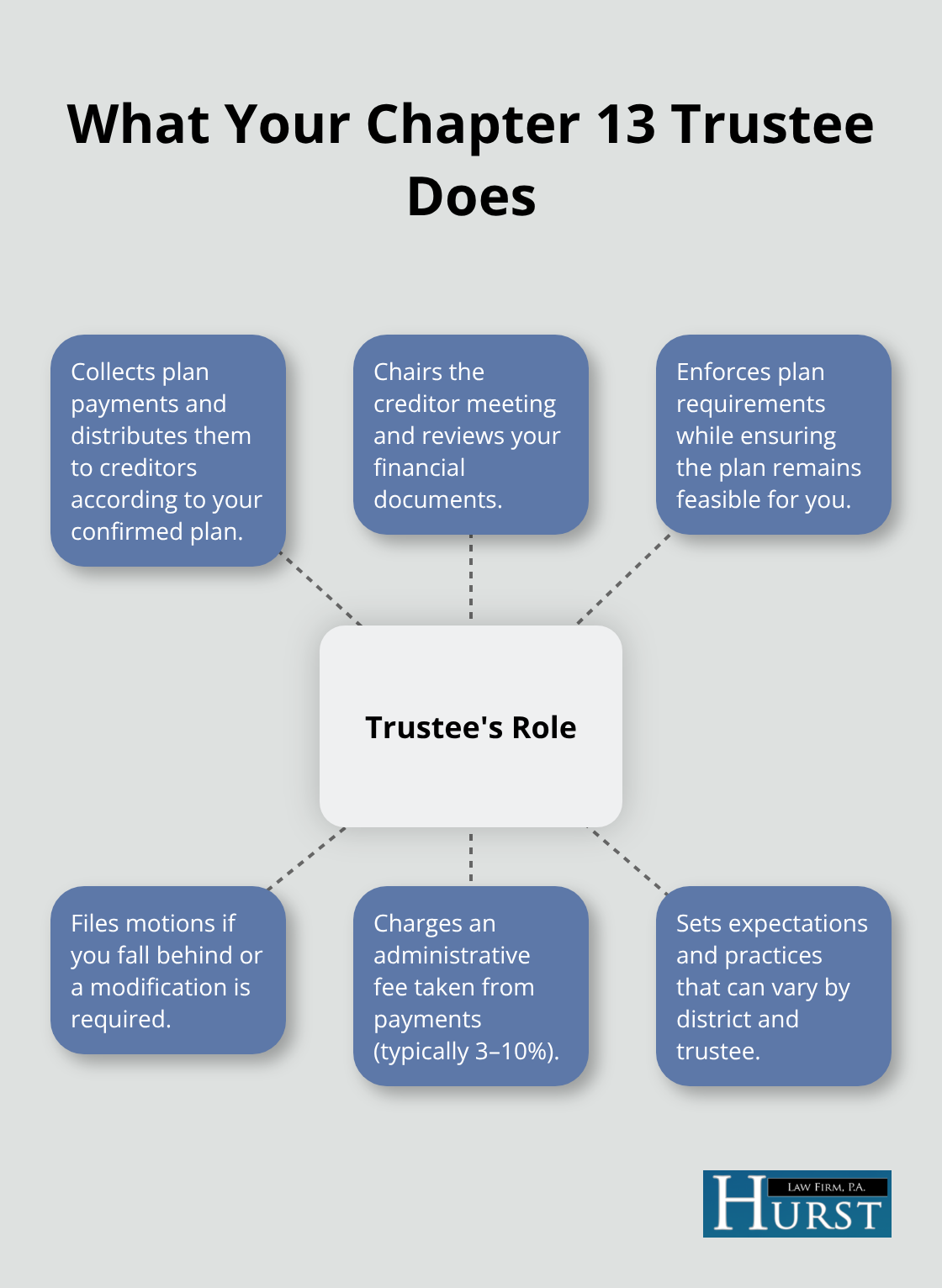
If you fall behind on payments, the trustee files a motion to dismiss your case or modify the plan, which is why consistent payments matter so much. The trustee also charges an administrative fee, typically ranging from 3 to 10 percent of payments collected, which comes out of your monthly payment before creditors receive their share (this fee covers the trustee’s staff, systems, and oversight responsibilities). You cannot choose your trustee, but you can ask your attorney questions about how your specific trustee handles common situations in your district, as practices vary between regions and even between individual trustees.
Understanding how your trustee operates and what they expect from you sets the foundation for a successful plan. The next section walks you through how to calculate the disposable income that forms the basis of your monthly payment obligation.
Building Your Repayment Plan
Your disposable income forms the foundation of your entire Chapter 13 plan, and calculating it correctly determines whether your plan receives court approval and whether you can actually complete it. Disposable income means money left over after you pay essential living expenses, and the court applies a strict definition that varies based on your income level.
Calculating Your Disposable Income
If you earn below the median income for your household size in your state, the court applies a straightforward calculation: take your gross monthly income, subtract actual necessary expenses like housing, utilities, food, transportation, and insurance, and what remains goes toward your plan payment. If you earn above the median income, the calculation becomes more complex because the court applies standardized expense allowances from the IRS National Standards and Local Standards, which may be higher or lower than your actual spending. This means high-income filers cannot simply claim they spend more on groceries than the IRS allows; the court caps certain expenses regardless of reality.
Gathering accurate pay stubs covering the past 60 days, tax returns from the prior two years, and a detailed household expense list before meeting with an attorney prevents delays and surprises during the filing process. Self-employed filers need to average their net business income over the preceding 12 months after deducting legitimate business and personal expenses, which requires clean bookkeeping and sometimes a tax professional’s input.
Organizing Debts by Priority
The court will not confirm a plan that shortchanges priority claims, so organizing your debts correctly matters tremendously. Priority debts include recent income taxes, child support, alimony, and certain wage claims, and these must be paid in full through your plan regardless of plan length. Secured debts like mortgages, car loans, and property liens come next; you must either pay these in full or surrender the asset, and if you have fallen behind on payments, the plan must cure those arrears while keeping current on ongoing payments.
Unsecured debts like credit cards, medical bills, and personal loans receive whatever money remains after priority and secured debts are covered, which often means they are paid at a fraction of what you owe. Before working with an attorney, gather statements from every creditor, note which debts are secured versus unsecured, identify any judgments or liens against your property, and calculate total arrears on any mortgage or vehicle loan.
Preparing Documentation for Your Attorney
This preparation allows your attorney to model realistic scenarios and show you exactly how much your creditors will receive under different plan structures. A five-year plan sometimes makes financial sense even if a three-year plan is technically possible, because spreading payments over 60 months rather than 36 months can significantly reduce your monthly obligation and improve your odds of successful completion. The documents you compile-pay stubs, tax returns, creditor statements, and expense records-form the backbone of your filing package and speed up the entire process.
With your disposable income calculated and your debts organized by priority, you now have the information needed to work with an attorney who can translate these numbers into a formal repayment plan that the court will review and either approve or modify.
Staying on Track During Your Plan
Make Your Monthly Payment a Top Priority
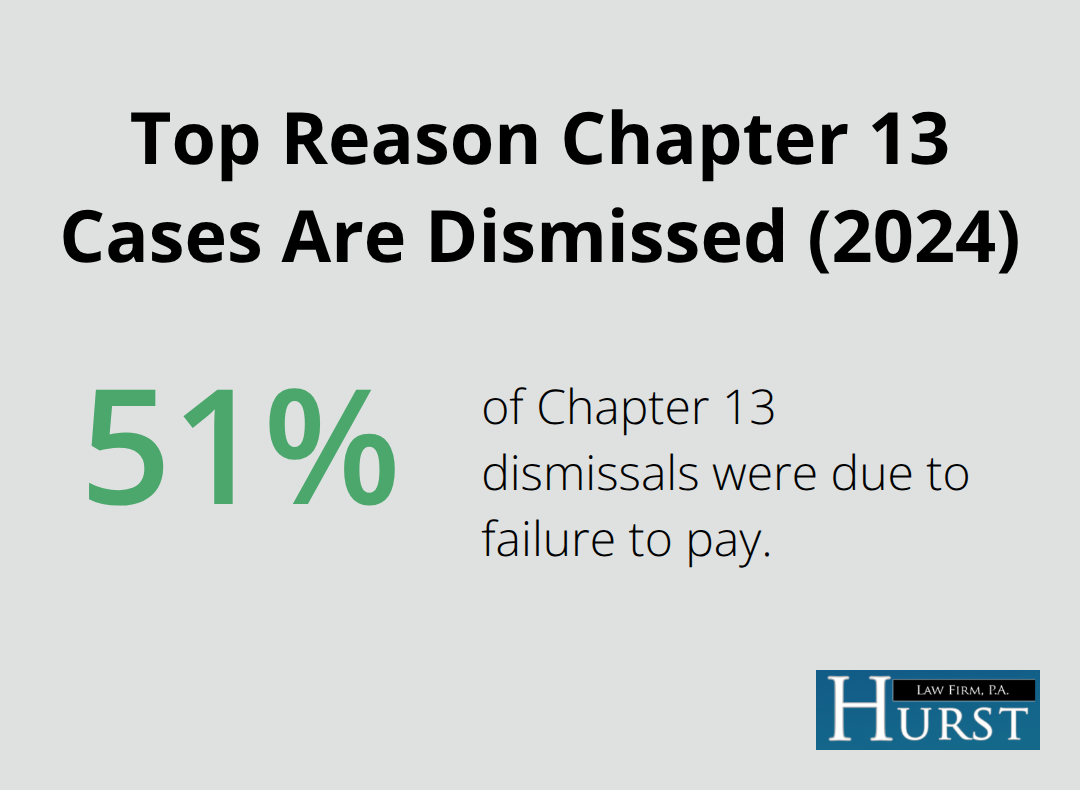
Your monthly payment to the trustee is non-negotiable, and the difference between success and dismissal often comes down to whether you treat it with the same priority as your mortgage or car payment. The U.S. Courts data from 2024 shows that 51 percent of Chapter 13 dismissals resulted from failure to pay, meaning nearly half of all cases that closed unsuccessfully did so because filers could not maintain consistent payments. This statistic underscores a hard truth: a well-designed plan means nothing if you do not pay it.
Set up automatic transfers from your bank account to the trustee on the same day you receive your paycheck, which eliminates the risk of spending money earmarked for the plan. Many trustees now accept online payments through their portals, and some offer mobile apps that let you track payment history and upcoming amounts in real time. Contact your assigned trustee immediately after filing to confirm their preferred payment method and ask whether they charge fees for certain payment types; some accept ACH transfers at no cost while charging fees for credit card payments.
Handle Income Changes Strategically
If your income increases during the plan, you are not required to immediately boost your payment, but you should communicate with your attorney about whether a plan modification makes sense from a strategic standpoint. Conversely, if your income drops significantly due to job loss, medical emergency, or reduced hours, you have the right to file a motion to modify your plan within a specific timeframe, typically before your case closes. The court will not automatically dismiss your case for a temporary income dip if you act quickly and propose a realistic revised payment schedule.
Do not ignore payment problems hoping they will resolve themselves; trustees and courts view proactive communication far more favorably than discovering months of missed payments later. If an unexpected expense arises (such as emergency car repairs or a medical bill not covered by insurance), do not raid your plan payment fund. Instead, contact your attorney to discuss whether a temporary hardship modification is available in your jurisdiction.
Build Financial Resilience
Some districts allow brief payment deferrals or temporary reductions if circumstances are genuinely beyond your control, though this varies significantly by trustee and bankruptcy judge. Building a small emergency fund outside your monthly budget, even if it is only twenty or thirty dollars per week, provides a buffer against minor financial shocks without derailing your entire plan. Review your budget quarterly with a financial counselor to identify areas where you can reduce spending and protect your plan payments from competing demands (this proactive approach prevents the financial stress that leads to missed payments).
Final Thoughts
A Chapter 13 repayment plan succeeds when you treat your monthly payment with the same discipline you apply to your mortgage or car loan. The data shows that nearly 50 percent of dismissed cases fail because filers stop paying, while those who maintain consistent payments see their remaining eligible debts discharged and their credit rebuild over time. Your plan is not punishment-it is a legal structure that lets you keep your home, your car, and your financial dignity while you reorganize what you owe over three to five years.
The trustee assigned to your case works to collect your payments, distribute funds fairly to creditors, and enforce the plan terms that protect everyone involved. When you communicate proactively about income changes or unexpected hardships, you demonstrate the financial responsibility that courts and trustees respect. Automating your payments, building a small emergency fund, and reviewing your budget quarterly are practical steps that separate successful filers from those who struggle to complete their plans.
We at Hurst Law Firm, P.A. have guided Memphis residents through Chapter 13 bankruptcy since 1997, and we understand the financial stress that leads families to consider this option. Our role is to translate your income, expenses, and debts into a realistic plan that the court will approve and that you can actually complete. If you are considering Chapter 13 or want to understand whether it fits your situation, contact us to discuss your options with someone who knows Memphis bankruptcy law and your community.